What AI Humanizers Can and Cannot Do: Limits and Truth
What can AI humanizers really do? They rewrite text to vary sentence length and swap stiff words. This can improve flow and break up robotic phrasing. But humanizers cannot guarantee that text will pass every detector. They also cannot fact-check claims, conduct research, or replace genuine human thinking.
What can an AI humanizer effectively accomplish?
A humanizer effectively restructures repetitive syntax, eliminates robotic clichés, and introduces healthy sentence variation.
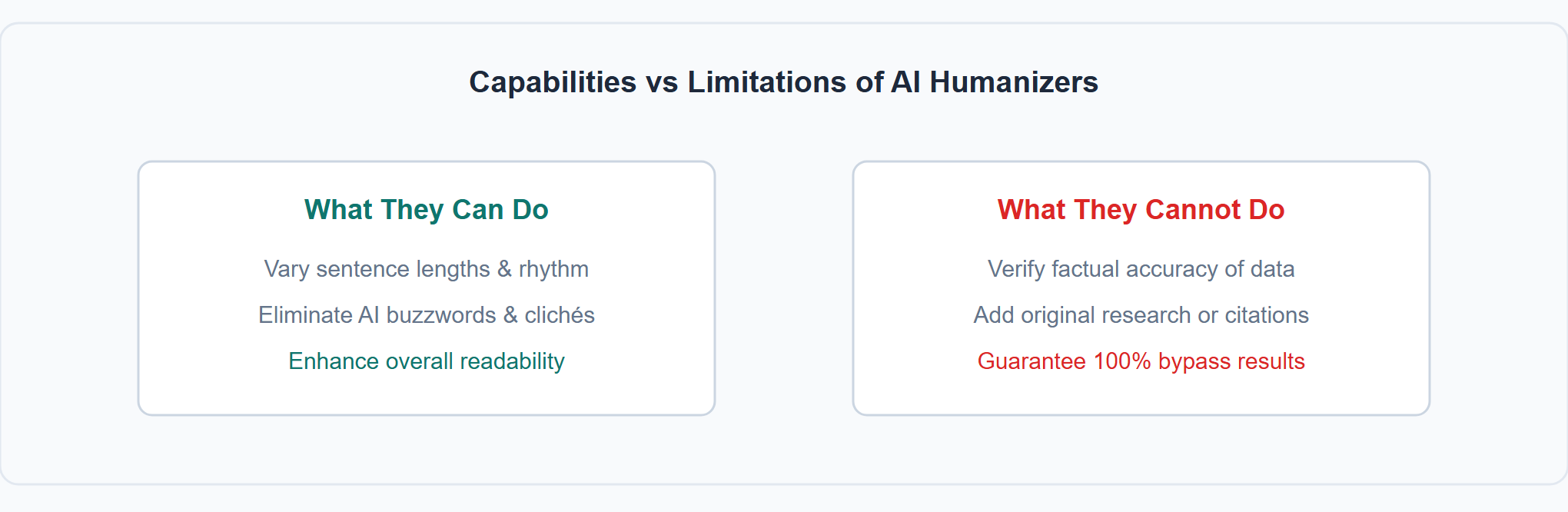
A text humanizer is defined as a software tool that restructures syntax to increase burstiness and vary vocabulary. Hallucination risk refers to automated tools introducing factual errors during rewriting. Editorial oversight means human review that verifies claims before publication. While automated paraphrasing tools can introduce stylistic variability, they often introduce factual drift or subtle distortion in technical and legal phrasing, necessitating diligent human oversight.
What are the core limitations that writers must keep in mind?
The biggest limitations are factual drift, loss of nuanced domain terminology, and the inability to guarantee zero-risk detection across all platforms.
| Tool Claim | Real-World Reality | Best Human Practice |
|---|---|---|
| "100% Undetectable Guarantee" | Detectors frequently update classifiers and catch modified patterns | Focus on genuine human editing and clear communication |
| "Automatic Fact Preservation" | Aggressive synonym swaps often distort scientific or legal claims | Always review technical terminology by hand |
| "Instant Authentic Voice" | Tools produce generic conversational tone, not your unique style | Inject your personal anecdotes, data, and perspectives |
For instance, relying on a tool to bypass detection is an endless game of cat-and-mouse. Consider how the ACL RAID Benchmark (2024) showed that as detectors update to catch paraphrased patterns, evasive tools must change again. The only permanent solution is authentic human ownership of your writing. Test your text on our AI writing detector to evaluate your baseline rhythm.
How should responsible authors integrate humanizers into their workflow?
Use humanizers as brainstorming aids to break through writer's block, then carefully revise the text yourself.
Our text revision tool is designed to help authors explore varied phrasing while keeping facts intact. To learn more about our testing standards, visit our AI writing detector page to inspect your draft.
- Use revision tools to suggest alternative sentence openings and clause structures.
- Carefully verify all factual claims, quotes, numbers, and source citations.
- Inject your unique personal voice, opinions, and lived experiences.
- Review ethical writing practices for guidance on responsible composition.
Common questions
Can an AI humanizer make my writing 100% undetectable?
No. Marketing guarantees of 100% bypass are misleading. Detection tools continuously update their models to detect paraphrasing.
Will using a humanizer introduce factual mistakes?
It can. Automated rewriters sometimes swap synonyms that alter the precise meaning of legal, medical, or technical concepts.
What is the best way to use a humanizer responsibly?
Use it as a creative revision assistant: take its suggestions for varied sentence structures, but review and edit the final prose yourself.
Sources and further reading
- ACL 2024 RAID Benchmark on Paraphrasing Attacks — Study on detector resilience against automated rewriters
- NIST 2024 GenAI Text-to-Text Evaluation Pilot Study — Federal technical standards on machine-modified text
- OpenAI Classifier Deprecation and Limitations — Analysis of detection challenges and classifier limitations
Related TruthDraft tools and guides
- AI writing detector — test text patterns and evaluate false-positive risk.
- Text revision tool — explore alternative phrasing while preserving factual accuracy.