What Happens to Submitted Text? Privacy, Logs, and Safety
What happens when you paste text into an AI detector? The tool sends your draft to remote servers. Some services process text in memory and delete it right away. Others save your writing to train future models or share it with third parties. Writers must check data policies before pasting private notes or client work.
How do different services handle your submitted text?
Services vary between zero-retention memory processing and permanent database storage used for model training.
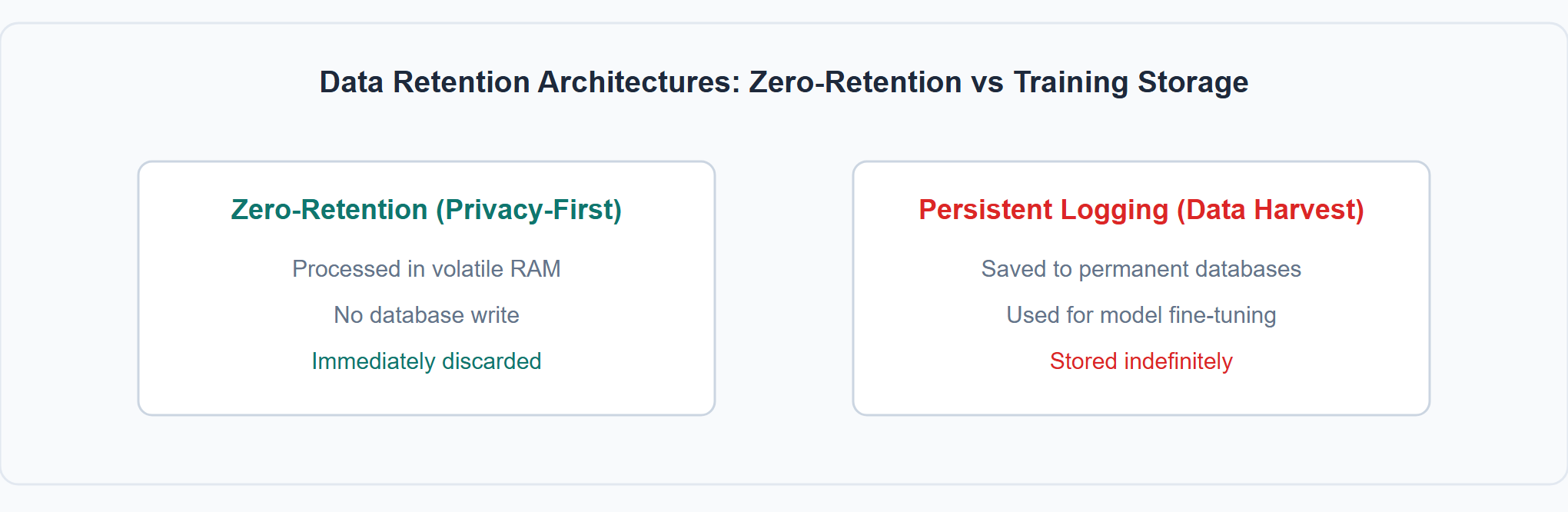
Zero retention is defined as an architecture where server memory discards input text immediately after returning results. Model fine-tuning refers to training algorithms on customer inputs to improve future accuracy. Data anonymization means stripping identifying personal details before storing records. Transparent services explicitly specify data retention timelines and state whether submitted text is anonymized or excluded from machine learning training datasets.
What privacy red flags should writers look for in terms of service?
Watch out for clauses granting perpetual licenses to use your content, mandatory AI training, or vague third-party data sharing.
| Privacy Feature | Safe Provider Practice | Warning Red Flag |
|---|---|---|
| Data Retention | RAM-only processing; 0-day storage | Retained indefinitely in provider databases |
| Training Rights | Never used to train commercial models | Terms claim a perpetual license to train AI |
| Third-Party Sharing | No third-party resale or sharing | Shared with marketing and analytics partners |
| Encryption | TLS in transit and AES-256 at rest | No mention of standard encryption protocols |
For instance, always verify whether a tool is subject to regulations like the European Union GDPR or the FTC Privacy Guidelines. TruthDraft operates under a strict privacy-first approach: we do not store, archive, or train models on your writing submissions. Consider testing your draft securely on our AI writing detector.
How can you protect sensitive manuscripts and business text?
Remove client names and private information before testing, choose zero-retention tools, and read privacy disclosures carefully.
Our text revision tool processes text securely without logging your drafts. Review our privacy policy for complete data handling disclosures.
- Redact sensitive names, addresses, and numbers before pasting text.
- Check the provider's privacy policy for explicit zero-retention guarantees.
- Avoid using obscure free tools with no clear corporate ownership.
- Review applicable consumer privacy standards and data protection guidelines.
Common questions
Does TruthDraft store my submitted writing?
No. TruthDraft routes submissions over encrypted TLS to third-party processing providers solely to compute results. We do not maintain an essay archive, database, or train models on your writing.
Can an AI detector publish my unpublished manuscript?
If a service terms grant perpetual licenses, they may use text for internal model training, though direct public release is rare.
Is it safe to paste client work into online detectors?
Only use services that explicitly guarantee zero data retention and strict confidentiality under enterprise privacy terms.
Sources and further reading
- European Union General Data Protection Regulation (GDPR) — Official EU data protection principles and privacy requirements
- FTC Business Guidance on Privacy and Security — Federal Trade Commission standards on consumer data handling
- NIST 2024 GenAI Privacy and Security Guidelines — Government framework for responsible generative AI deployment
Related TruthDraft tools and guides
- AI writing detector — test text patterns and evaluate false-positive risk.
- Text revision tool — explore alternative phrasing while preserving factual accuracy.