Student Guide: False AI Accusations, Draft Proof, and Integrity
A false AI accusation is stressful, but you can prove your work. Detectors make frequent mistakes and cannot prove cheating. You can show your real writing process with version history logs, research notes, and draft outlines. These tangible records disprove statistical guesses and protect your academic record.
What should you do immediately if falsely accused?
Stay calm, review the syllabus policy on AI tools, and collect your drafting materials immediately before attending any meeting.
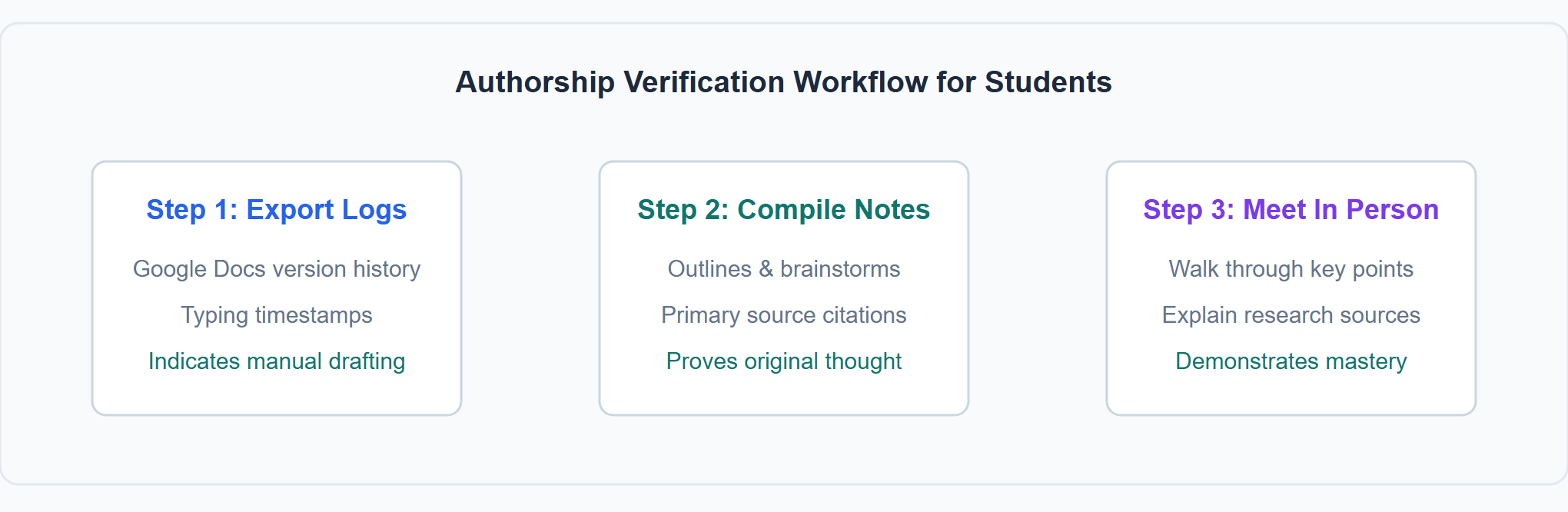
Academic integrity is defined as the ethical commitment to honest scholarship and original drafting. Version history refers to timestamped records showing progressive edits and manual typing. A drafting trail means the collection of outlines, notes, and sources created during the writing process. Transparent version histories showing incremental drafting, outline development, and reference gathering provide compelling evidence of authentic academic effort during review proceedings.
What evidence best proves authentic human authorship?
The best evidence is a continuous drafting history showing gradual typing, revisions, deletions, and research timestamps over multiple days.
| Evidence Type | How to Obtain It | Strength in Academic Appeals |
|---|---|---|
| Google Docs Version History | File > Version History > See version history | High (shows progressive manual typing) |
| Research Outlines & Notes | Dated notebook pages, voice memos, or scratch files | High (proves intellectual progression) |
| Browser Research History | Export search queries and library database visits | Moderate (corroborates source discovery) |
| Earlier Writing Samples | Submissions from previous classes | Moderate (establishes your stylistic baseline) |
For instance, Turnitin explicitly advises educators in its AI Report Guidelines that automated scores should never be used as sole proof. Major institutions like Vanderbilt University have disabled Turnitin AI detection due to false-positive risks. Consider checking your draft on our AI writing detector to understand why a tool flagged it.
How can students protect themselves on future assignments?
Write directly in cloud documents with automatic version tracking, keep your research notes organized, and clarify policies with your instructors.
If you want to refine sentence variety before submitting your next paper, try our text revision tool. To learn more about our testing standards, visit our AI writing detector page to inspect your draft.
- Always draft assignments in Google Docs or Word with cloud version tracking enabled.
- Save all brainstorms, outlines, and initial research notes in a dedicated folder.
- Ask professors to clarify permissible uses of grammar and research tools.
- Review institutional integrity policies for fair review standards.
Common questions
Can an instructor fail me solely based on an AI detector score?
At most universities, no. Academic policies typically require human evidence beyond an automated score before penalizing a student.
How do I export Google Docs version history as proof?
Open your document, go to File > Version history > See version history, and expand the edits to show your step-by-step drafting.
Does using Grammarly make my paper look like AI?
Accepting many automated phrasing suggestions can lower sentence variety, which sometimes triggers higher scores on sensitive detectors.
Sources and further reading
- Turnitin AI Writing Report Interpretation and Limitations — Vendor warning against punitive action based solely on automated scores
- Vanderbilt University Decision to Disable Turnitin AI Detector — University policy citing unreliability and false-positive harm
- Stanford Study on Detector Bias (Liang et al.) — Analysis of 61% false-positive rates on non-native writing samples
Related TruthDraft tools and guides
- AI writing detector — test text patterns and evaluate false-positive risk.
- Text revision tool — explore alternative phrasing while preserving factual accuracy.