How to Make Your Writing Sound Like You: Voice and Style
Making your writing sound like you requires embracing authentic human style. Robotic prose is flat, predictable, and repetitive. You can bring text to life by varying your sentence lengths, using natural conversational rhythms, sharing specific personal observations, and eliminating generic buzzwords.
What causes writing to sound stiff and artificial?
Writing sounds stiff when it relies on uniform sentence lengths, passive voice, and generic filler words. This monotone style mimics the low-burstiness output of AI models.
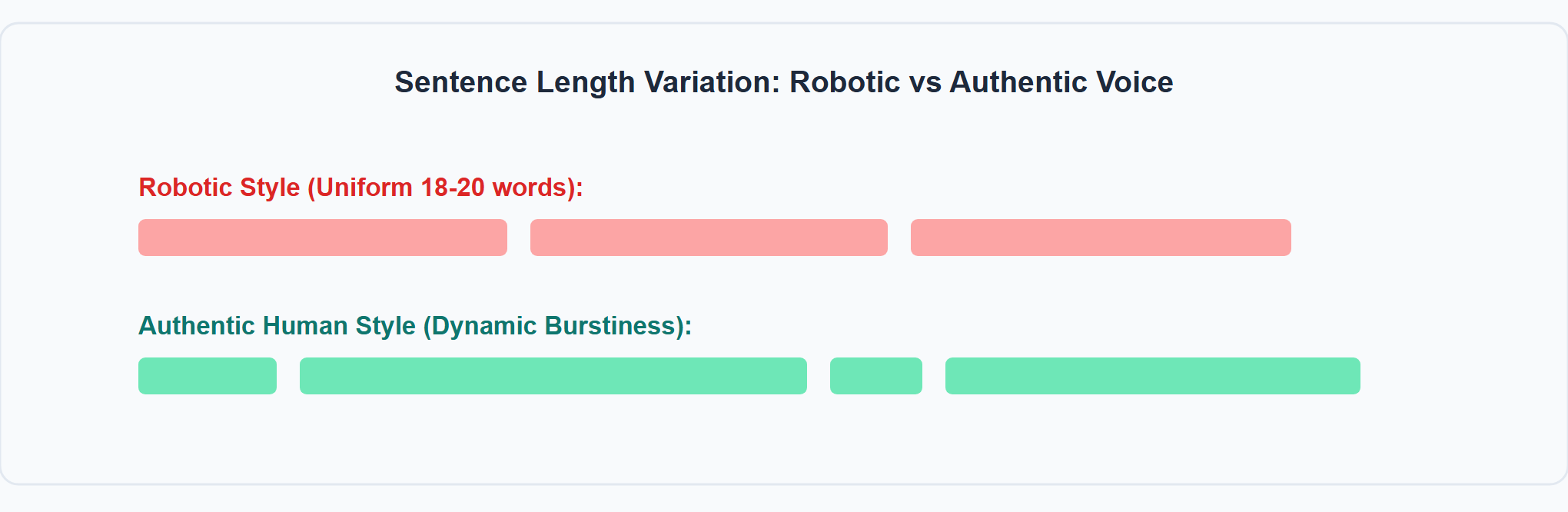
Voice is defined as the distinct personality and perspective that comes through in writing. Sentence cadence refers to the rhythm and musicality created by alternating short and long clauses. Filler phrasing means unnecessary words that pad a sentence without adding meaning. Alternating between concise declarations and elaborate explanatory clauses creates natural cadence that holds reader interest while distinguishing your writing from formulaic machine outputs.
What practical techniques bring personal voice into a draft?
You can inject personal voice by using active verbs, adding concrete examples, and reading your work aloud to catch awkward phrasing.
| Stiff / Robotic Habit | Authentic Human Alternative | Why It Works |
|---|---|---|
| "It is important to remember that..." | "Remember:" or "Keep in mind:" | Cuts wordy filler; delivers value instantly |
| "Delve into the multifaceted realm" | "Explore the topic" or "Look at the data" | Eliminates artificial AI clichés |
| Uniform 20-word sentences | Mix 5-word statements with 25-word explanations | Creates natural burstiness and rhythm |
| Passive corporate statements | Direct first-person or second-person address | Engages readers in a direct conversation |
For instance, great writers treat prose like speech: they pause, emphasize, and simplify. Consider how writing guidelines from Purdue OWL emphasize conciseness and active verbs as the foundation of strong prose. You can check your sentence rhythm with our AI writing detector to ensure your draft has healthy structural variance.
How do you refine a draft without losing your core meaning?
Refine your draft in layers: first fix your arguments, then tighten sentence rhythm, and finally polish individual word choices.
If you want help testing alternative sentence structures, try our text revision tool to explore fresh phrasing while keeping your message intact. For our testing data, test your draft on our AI writing detector.
- Focus on one main point per paragraph to keep arguments clear.
- Cut introductory throat-clearing phrases like 'in conclusion' or 'it is crucial.'
- Read your draft aloud to verify that the rhythm feels natural.
- Follow clear style guidelines to keep your message engaging and authentic.
Common questions
Why does my writing get flagged by AI detectors when I wrote it myself?
If you write in a formal, highly structured style with consistent sentence lengths, detectors may mistake your disciplined rhythm for machine text.
How can I increase the burstiness of my writing?
Mix very short sentences with longer compound sentences. Follow an in-depth explanation with a punchy three-word summary.
Does using active voice help avoid AI detection?
Yes. Active voice creates more direct, natural phrasing and reduces the formulaic passive structures commonly generated by language models.
Sources and further reading
- Purdue Online Writing Lab (OWL) Conciseness Guide — Standard academic reference on active voice and eliminating filler words
- NIST 2024 GenAI Text Evaluation Study — Data on structural metrics in human versus synthetic text
- ACL 2024 RAID Benchmark — Analysis of stylistic markers across human and machine corpora
Related TruthDraft tools and guides
- AI writing detector — test text patterns and evaluate false-positive risk.
- Text revision tool — explore alternative phrasing while preserving factual accuracy.