Can Rewritten AI Text Still Be Detected?
Can tools spot rewritten AI text? Yes, if you only swap synonyms. Detectors check sentence rhythm and clause patterns, not just single words. Simple word swaps leave sentence shapes intact. But deep human editing changes this completely. When you rewrite paragraphs in your own voice, detection scores drop sharply.
Why do simple rewrites often fail to avoid detection?
Simple rewrites fail because detectors evaluate grammatical cadence and sentence flow, not just isolated vocabulary words.
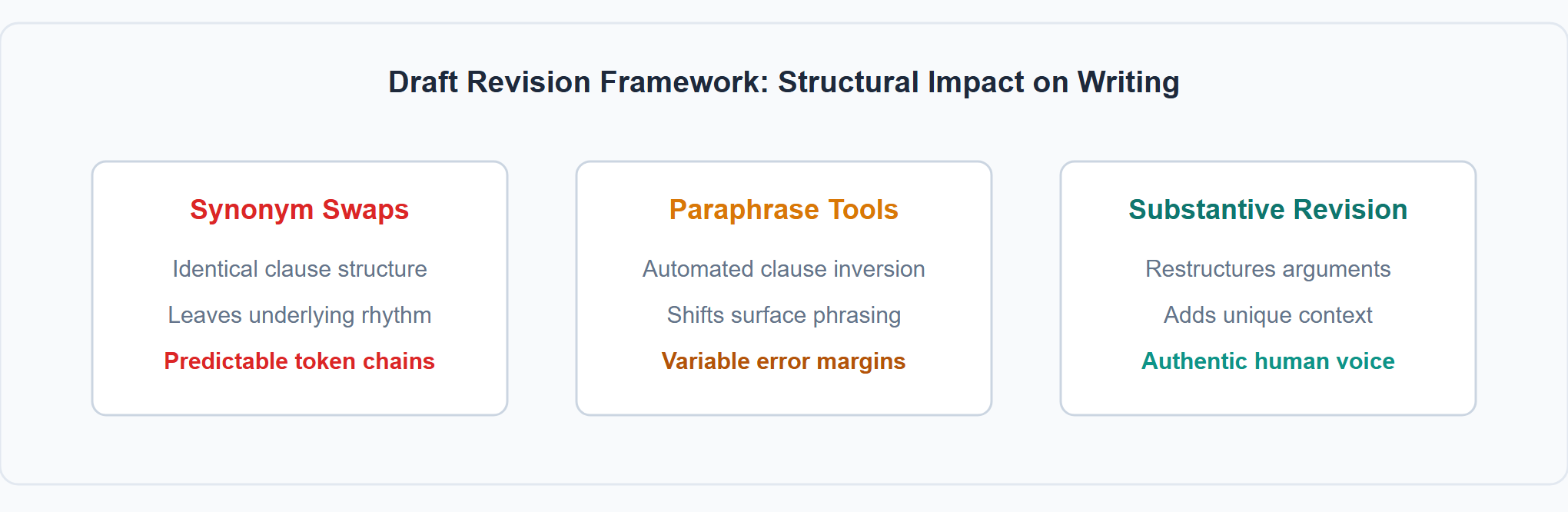
Syntactic cadence is defined as the rhythmic pattern of sentence lengths and clauses across a paragraph. A paraphrasing attack refers to automated rewriting designed to fool text classifiers. Deep editing means restructuring arguments, changing voice, and adding unique evidence. Superficial synonym substitution leaves grammatical cadence unchanged, whereas substantive restructuring alters sentence rhythm and vocabulary distributions.
What makes human editing fundamentally different from automated rewrites?
Human editing introduces unique personal voice, varied sentence lengths, and concrete real-world details that automated rewriting tools cannot generate.
| Editing Approach | Structural Impact | Detection Outcome |
|---|---|---|
| Thesaurus Swapping | Identical clause structure; swapped nouns/verbs | High detection (statistical cadence preserved) |
| Spinner / Paraphraser | Formulaic clause flips; often introduces awkward phrasing | Moderate detection (predictable rephrasing patterns) |
| Structural Restructuring | Mixes sentence lengths; changes active/passive voice | Low detection (disrupts low-burstiness signature) |
| Personal Voice Injection | Adds first-hand examples, idiomatic phrasing, fresh data | Minimal detection (authentic human lexical diversity) |
For instance, independent studies in the ACL RAID Benchmark (2024) demonstrate that automated paraphrasing tools create their own detectable statistical artifacts. Detectors often degrade when evaluating paraphrased or modified text. Consider testing your own revisions on our AI writing detector to check your text rhythm.
How can writers authentically rewrite drafts for maximum clarity?
Focus on clear communication, strong thesis arguments, and personal examples rather than trying to game an algorithm.
If you want to explore alternative phrasings without losing clarity, try our text revision tool. For more details on text analysis, visit our AI writing detector page to inspect your draft.
- Read your draft aloud to spot awkward, robotic phrasing.
- Vary your sentence lengths: follow long explanations with short, punchy statements.
- Add specific case studies, numerical data, and personal observations.
- Follow established academic and editorial standards for authentic writing.
Common questions
Can paraphrasing tools remove AI detection?
No tool provides a guarantee. Paraphrasing utilities often produce predictable syntactic patterns, while detector models update continuously. Authentic personal drafting remains the only reliable path to clear, original writing.
Can an AI detector tell if text was edited by a human?
Detectors cannot see who edited a text. They only measure whether the final statistical patterns resemble machine output.
Can AI text be made undetectable?
No edit or tool guarantees that text will permanently pass every detector. Because detectors rely on probabilistic models that disagree and change over time, attempting to evade thresholds is futile. Focus instead on honest drafting, documenting your sources, and developing your own voice.
Sources and further reading
- ACL 2024 RAID Benchmark on Paraphrasing Attacks — Study on detector resilience against automated rewriters
- NIST 2024 GenAI Text-to-Text Evaluation Study — Federal benchmark data on modified synthetic text
- Stanford Study on Detector Vulnerabilities (Liang et al.) — Analysis of classifier fragility under stylistic variations
Related TruthDraft tools and guides
- AI writing detector — test text patterns and evaluate false-positive risk.
- Text revision tool — explore alternative phrasing while preserving factual accuracy.