How AI Writing Detectors Work: Scores, Limits, and Errors
AI detectors do not prove who wrote a paper. They measure word patterns like perplexity and burstiness. Then they pass these numbers to a model trained on text samples. Because human writing often looks like machine text, tools make mistakes. You should treat any score as an estimate, not absolute proof.
How do AI detectors evaluate a passage?
A detector measures how predictable your words look to an AI language model. It breaks text into tokens, checks probabilities, and scores sentence variety.
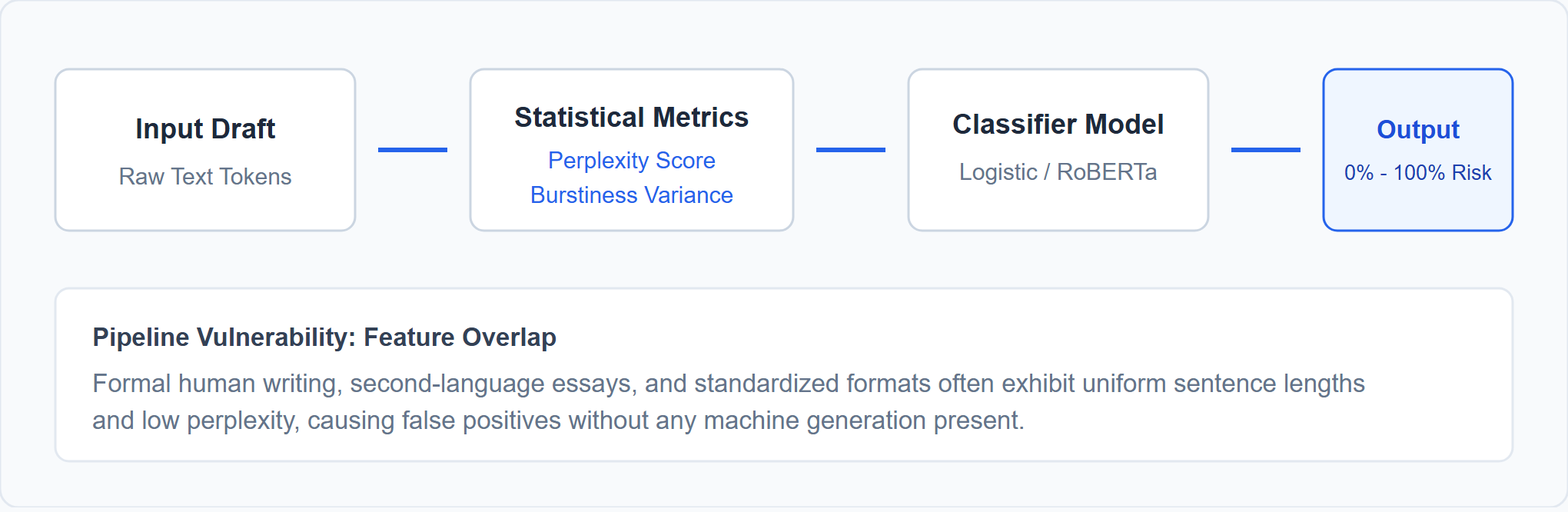
Perplexity is defined as a metric that measures how predictable a word choice is to an AI model. When text uses common word chains, its perplexity stays low. In contrast, burstiness refers to variation in sentence length and rhythm across a document. Humans naturally mix short, punchy statements with longer sentences. A classifier model means the software layer that maps these metrics into a final probability score. When human writing exhibits uniform sentence lengths and standard transitions, statistical classifiers are substantially more likely to flag it as synthetic.
Why do different detectors give conflicting scores?
Different detectors give conflicting scores because each tool uses its own training data and score rules. A score of 70% might mean 70% of the text looks synthetic, or it might mean 70% confidence that the whole paper is AI.
| Detector System | Primary Scoring Metric | Document Granularity | Key Documented Limitation |
|---|---|---|---|
| GPTZero | Perplexity & Burstiness | Sentence-level highlight | Higher false-positive rates on formal academic drafts |
| Turnitin AI | Proprietary Transformer | Block-level percentage | Advises against disciplinary action on score alone |
| Originality.ai | Fine-tuned RoBERTa | Full-document confidence | Aggressive confidence threshold flag rates |
| Copyleaks | Cross-entropy analysis | Fragment-level classification | Sensitivity to domain shifts and edited quotes |
For instance, commercial detectors often disagree because they rely on different baseline corpora. Consider how the ACL RAID Benchmark tested leading tools across 8 model types. The study showed that detector scores dropped sharply when facing new model updates or light paraphrasing. Before trusting any number, test your draft with our AI writing detector to check sentence variety.
How should institutions handle a flagged passage?
Institutions should treat flagged text as an invite for a calm conversation, never as proof of cheating. Educators must check a student's drafting notes before taking any action.
For example, OpenAI shut down its own detector in 2023 because it only caught 26% of AI text and falsely flagged human writers. If you need to revise stiff sentences, our text revision tool helps improve sentence rhythm while preserving your authentic voice. For fair review steps, inspect your draft on our AI writing detector.
- Check edit history logs, document timestamps, and progressive draft revisions.
- Inspect research notes, source citations, and interview transcripts.
- Hold a calm talk with the author about their main ideas.
- Consult institutional guidelines for fair review steps.
Common questions
Can an AI detector prove that someone cheated?
No. Detectors check statistical patterns in text. They cannot observe drafting or prove who wrote the words.
Why do AI detectors flag essays by non-native English speakers?
Writers using English as a second language often choose standard words and even sentence lengths. Detectors mistake this consistency for AI text.
Does light editing remove an AI detection flag?
Not always. Swapping synonyms leaves the underlying sentence rhythm intact.
Sources and further reading
- ACL 2024 RAID Benchmark for Machine-Generated Text — Comprehensive multi-detector benchmark testing robustness
- NIST 2024 GenAI Text-to-Text Evaluation Pilot Study — Federal measurement criteria and detector performance parameters
- OpenAI Classifier Deprecation and Limitations — Historical analysis of classifier unreliability and 26% success rate
Related TruthDraft tools and guides
- AI writing detector — test text patterns and evaluate false-positive risk.
- Text revision tool — explore alternative phrasing while preserving factual accuracy.