Common AI Detector Myths: What They Can and Cannot Do
AI writing detectors are widely misunderstood. Many believe they are 99% accurate, spot invisible digital watermarks, or provide proof of cheating. In reality, detectors calculate statistical probabilities. They make frequent errors on human writing, especially on non-native English essays and formal technical reports.
Myth 1: AI detectors are ninety-nine percent accurate
Marketing claims of 99% accuracy reflect narrow lab tests with unedited text. Independent tests show real-world scores swing between 40% and 80%.
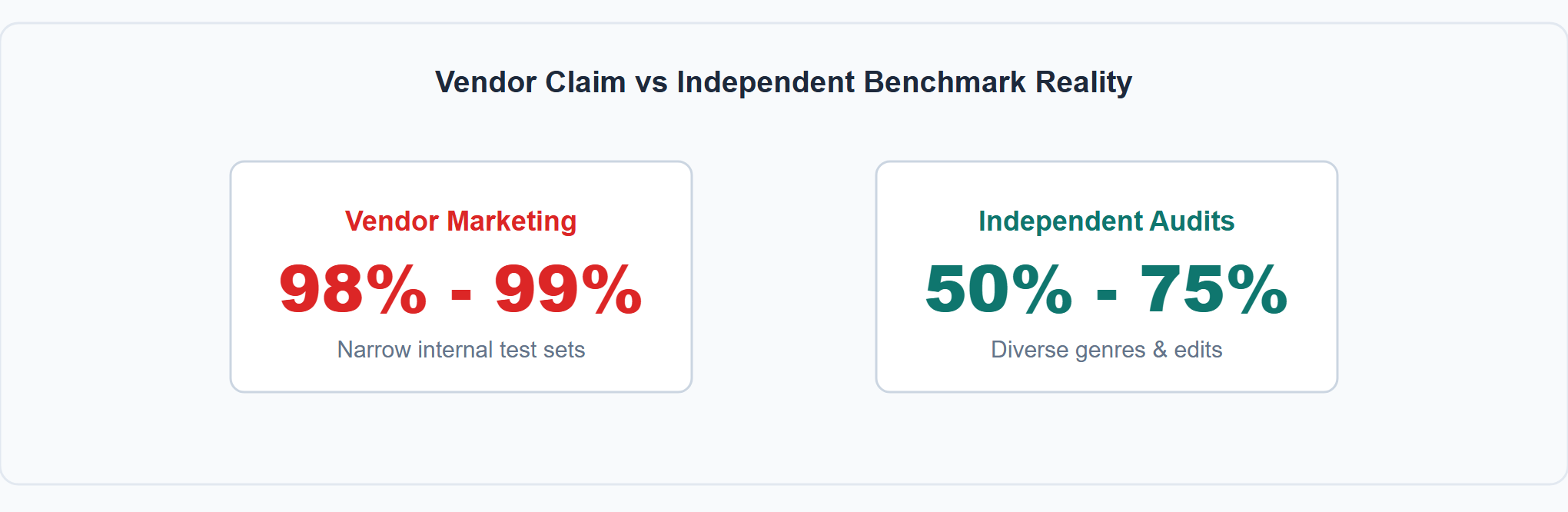
A benchmark audit is defined as an independent test comparing software against real-world data. In-distribution testing refers to testing software on the same type of data it trained on. Out-of-domain failure means a tool breaking down when given new writing topics. Independent benchmarks demonstrate that when detectors encounter writing styles, technical vocabularies, or topic domains outside their training distribution, classification accuracy drops substantially.
Myth 2: AI models leave invisible digital watermarks in text
Standard AI models like ChatGPT and Claude do not embed digital watermarks in plain text. Detectors look for word patterns, not hidden signatures.
| Popular Myth | The Reality | Scientific Source |
|---|---|---|
| AI text has hidden watermarks | Plain text contains only Unicode characters; no hidden code exists | NIST 2024 GenAI Study |
| Detectors are 99% accurate | Accuracy drops to 40%-75% on paraphrased or diverse text | ACL RAID Benchmark (2024) |
| Scores prove cheating | Scores are probabilistic estimates, not legal or academic proof | Turnitin AI Guidelines |
| Human writing never gets flagged | Non-native English essays face false flag rates over 60% | Liang et al. (Stanford 2023) |
Plain text files hold only characters and spaces. For instance, a detector can only measure how common those words are. Consider how the NIST GenAI Pilot Study showed that statistical detectors cannot verify origin without raw metadata. Test your text on our AI writing detector to understand your predictability score.
Myth 3: An AI detector score provides solid proof of misconduct
A detector score is an algorithmic guess, not legal or academic proof. Schools must review draft histories before taking any disciplinary action.
Universities like Vanderbilt have disabled AI detectors due to high false flag rates on innocent students. If you want to refine sentence variety in your work, try our text revision tool. Learn more about our testing at our research methodology page.
- Check document version history for regular typing sessions.
- Review student outlines, notes, and cited sources.
- Conduct an informal discussion about key arguments and ideas.
- Consult institutional honor codes for fair evaluation policies.
Common questions
Can an AI detector tell whether I used ChatGPT or Claude?
No. Detectors evaluate general token predictability. They cannot identify the specific model that generated the text.
Why do AI detectors flag older texts written before AI existed?
Historical texts with formal grammar and repetitive sentence lengths have low perplexity. Detectors mistake that structure for machine output.
Can an AI detector be wrong?
Yes. Detectors make frequent false-positive and false-negative errors across all writing styles.
Sources and further reading
- NIST 2024 GenAI Text-to-Text Pilot Study — Federal measurement criteria and detector performance evaluation
- ACL 2024 RAID Benchmark Study — Cross-domain peer-reviewed detector evaluation study
- Stanford Study on Detector Bias (Liang et al.) — Documenting high false-positive rates on non-native English writing
Related TruthDraft tools and guides
- AI writing detector — test text patterns and evaluate false-positive risk.
- Text revision tool — explore alternative phrasing while preserving factual accuracy.