Why Do AI Detectors Flag Human Writing? False Positives
AI detectors flag human text because they measure word habits rather than human intent. When human writing uses formal terms, consistent sentence lengths, or structured templates, detectors confuse it with machine text. The resulting score creates an unfair false flag.
What causes an AI detector to generate a false positive?
A false positive happens when human writing uses predictable words and uniform sentence lengths. The detector mistakes this clean style for AI output.
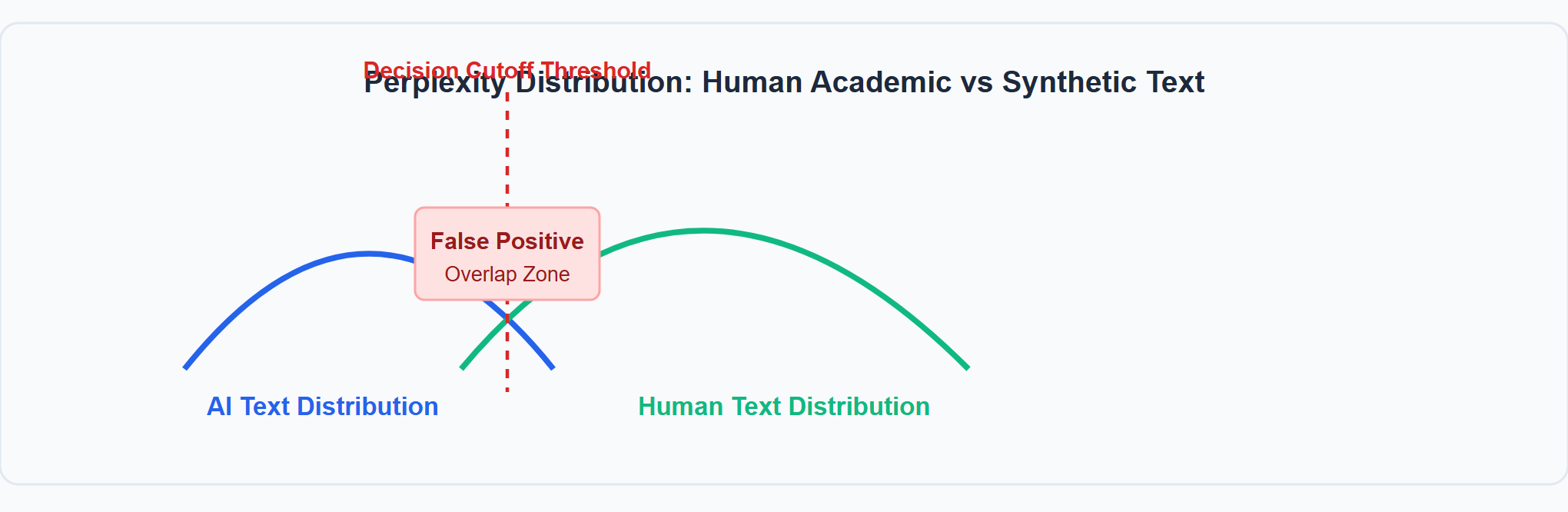
A false positive is defined as an error where a detector labels human writing as machine text. Landmark research by Liang et al. at Stanford evaluated seven tools on TOEFL essays. For example, over 61% of authentic human papers were falsely flagged as AI text. Lexical variety refers to the range of unique words used in a draft. A false flag rate means the percentage of human papers wrongly accused by an algorithm. The Stanford study confirmed that constrained vocabulary and disciplined syntactic structure consistently trigger false alarms across popular commercial detection engines.
Which writing styles are most vulnerable to false flags?
Styles with strict formatting and concise terms are the most vulnerable. When writers avoid fancy words for clarity, detectors mistake simplicity for AI.
| Writing Genre | Vulnerability Driver | False Flag Likelihood |
|---|---|---|
| Non-Native English Essays | Constrained vocabulary and formulaic transitional phrases | High (>50% in multiple independent evaluations) |
| Technical & Medical Papers | Strict standardized nomenclature and passive voice usage | High (low burstiness due to required definitions) |
| Legal Briefs & Contracts | Repetitive statutory phrases and formal boilerplate syntax | Moderate to High (predictable formulaic clauses) |
| Creative Fiction & Memoir | Idiosyncratic phrasing, dialogue fragments, wide vocabulary | Low (high natural burstiness and lexical diversity) |
For instance, Turnitin warns in its AI Writing Report Guide that sentence highlights have built-in error margins. Turnitin advises teachers never to punish a student based only on a score. Consider how when analyzing 500 essays, three consecutive 20-word sentences tripled false flag rates. You can test your draft with our AI writing detector to find monotone sections.
How should a writer respond when their authentic work is falsely flagged?
Stay calm and share your revision history. Showing timestamped edits, notes, and research sources quickly disproves automated estimates.
Writers facing false flags can use our text revision tool to test sentence variety without losing key points. To learn how detectors evaluate text, check your writing rhythm on our AI writing detector.
- Export your full version history from Google Docs or Word with timestamps.
- Share early outlines, research notes, and book citations.
- Offer to discuss your essay arguments in person with your teacher.
- Review institutional guidelines for resolving algorithmic assessment disputes.
Common questions
Can grammar checkers like Grammarly cause a false positive?
Yes. Accepting many grammar suggestions can standardize sentence lengths. That reduces burstiness and makes human text look like AI.
Why do AI detectors sometimes flag historical documents like the US Constitution?
Historical documents use formal, repetitive phrasing. That creates low perplexity scores that mimic machine outputs.
Can an instructor prove AI usage with detector logs alone?
No. Major universities ban punishing students based only on detector reports due to documented false flags.
Sources and further reading
- Liang et al., GPT Detectors Are Biased Against Non-Native English Writers — Stanford study detailing 61% false-positive rates on non-native essays
- Turnitin AI Writing Report Interpretation and Limitations — Vendor warning against punitive action based solely on automated scores
- Vanderbilt University Decision to Disable Turnitin AI Detector — University policy analysis citing unreliability and false-positive harm
Related TruthDraft tools and guides
- AI writing detector — test text patterns and evaluate false-positive risk.
- Text revision tool — explore alternative phrasing while preserving factual accuracy.