GPTZero vs Turnitin vs Originality.ai vs Copyleaks
Commercial detectors take very different approaches to finding AI text. GPTZero emphasizes perplexity and burstiness. Turnitin scans for block-level probability in classrooms. Originality.ai uses aggressive thresholds for web publishers. Copyleaks checks text entropy. Because their methods differ, running the same text through each tool produces widely varying scores.
How do the four leading detector platforms compare?
The four tools differ in their core models, training sets, and score cutoffs. Some flag whole documents, while others highlight individual sentences.
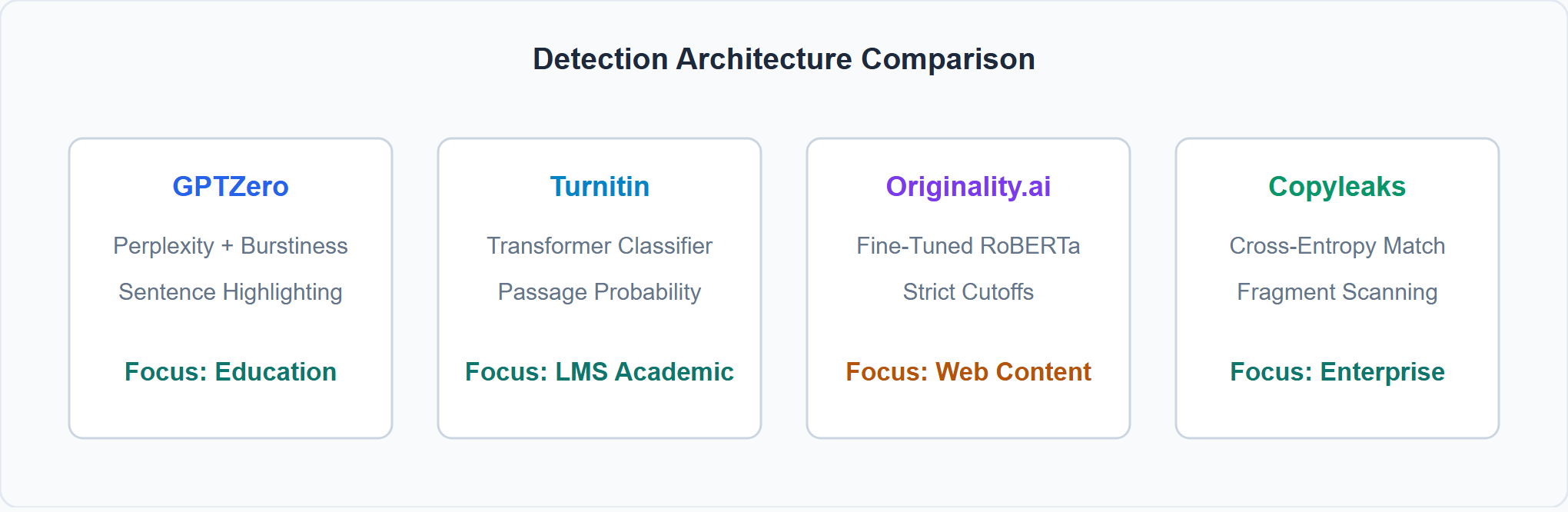
Cross-entropy analysis is defined as a method that compares word likelihood against reference models. Granularity refers to whether a tool scores full documents or individual sentences. A confidence score means the statistical probability assigned to a classification. Independent comparative evaluations indicate that running the same draft through multiple detectors often yields conflicting percentages, reflecting differences in training data, models, and decision cutoffs.
What does independent benchmark testing reveal?
Independent benchmark tests show that commercial detector accuracy drops sharply when evaluating paraphrased text or new models. Marketing claims of 99% accuracy do not hold up in independent studies.
| Feature / Metric | GPTZero | Turnitin | Originality.ai | Copyleaks |
|---|---|---|---|---|
| Primary Target | Education & General | Higher Ed LMS | SEO & Web Publishers | Enterprise & EdTech |
| False Positive Philosophy | Balanced / Conservative | Conservative (<1% target) | Aggressive (High recall) | Moderate |
| Public Access | Yes (Free & Paid) | No (Institutional Only) | Yes (Paid API) | Yes (Freemium) |
| Evaluation Profile | Public academic benchmarks & perplexity metrics | Proprietary classroom LMS; institutional evaluations | Commercial API; document-level web scans | Enterprise scans; cross-entropy analysis |
For instance, the ACL RAID Benchmark found that every tool struggled when writers lightly edited machine text. Consider testing your draft with our AI writing detector to check how your sentence variance compares across models.
Which detector should you trust for your use case?
Never trust any single tool as an absolute judge. Schools should use student-friendly review steps, while web publishers should check factual accuracy.
If your writing feels stiff or repetitive, our text revision tool helps improve sentence flow while keeping your core message intact. For our testing data, test your draft on our AI writing detector.
- For schools: Pair Turnitin or GPTZero with revision history checks.
- For publishers: Verify primary sources rather than chasing a 0% score.
- For authors: Focus on clear points and varied sentence rhythms.
- Review institutional integrity frameworks for fair review guidance.
Common questions
Which AI detector is the most accurate?
No single detector wins every test. Accuracy shifts depending on the text topic, length, and AI model used to create it.
Why does Originality.ai give higher AI scores than GPTZero?
Detectors apply different mathematical thresholds. Some tools prioritize high recall (flagging potential machine phrases aggressively), while educational tools prioritize precision to avoid falsely accusing students.
Can detectors reliably spot modern frontier AI models?
As language models evolve, their generated outputs exhibit richer vocabulary and varied sentence rhythm, making statistical differentiation from human writing increasingly difficult.
Sources and further reading
- ACL 2024 RAID Benchmark Study — Independent benchmark evaluating leading detector tools
- NIST 2024 GenAI Pilot Study — Federal evaluation benchmarks and measurement criteria
- Turnitin AI Writing Report Guide — Vendor documentation outlining score interpretation and limitations
Related TruthDraft tools and guides
- AI writing detector — test text patterns and evaluate false-positive risk.
- Text revision tool — explore alternative phrasing while preserving factual accuracy.