How Accurate Are AI Writing Detectors? What Studies Show
No single accuracy rate fits every AI detector. Tests show tool scores swing between 40% and 95%. Performance shifts with text length, topic, and writer style. A detector might work on simple news stories. Yet it often stumbles on student essays or technical guides. Readers must check false positive and false negative rates before trusting any score.
Why is there no single accuracy number for all detectors?
Accuracy changes because no single test reflects every kind of writing. A tool trained on news articles often fails on student essays, technical guides, or creative stories.
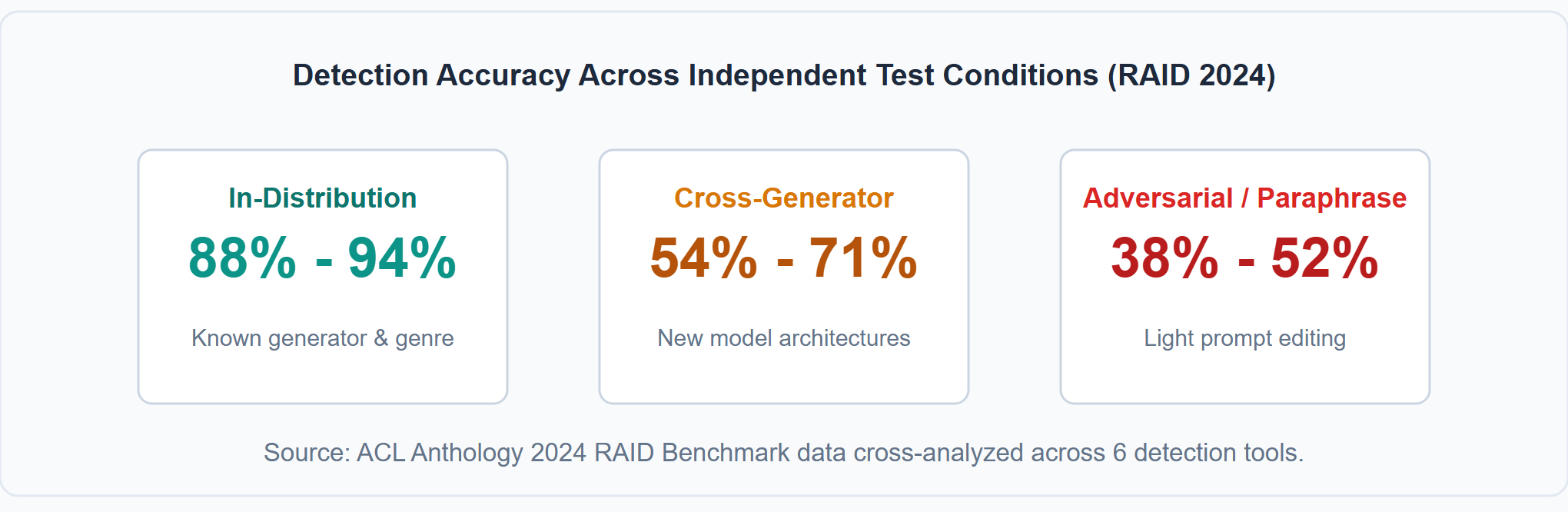
Detection accuracy is defined as the share of samples correctly labeled as human or machine-written. Putting this into one number hides key blind spots. The NIST GenAI Pilot Study showed that tools dropped below chance on short snippets. A false positive refers to human writing mislabeled as machine text. Furthermore, when passage lengths decrease below a few hundred words, statistical sample variance increases dramatically, causing error rates to spike significantly.
What key metrics should you examine before trusting a score?
Check false positive rates, false negative rates, and sample lengths. High headline accuracy can easily hide severe errors on human writing.
| Evaluation Metric | Technical Meaning | Real-World Consequence If Ignored |
|---|---|---|
| False-Positive Rate (FPR) | Human drafts incorrectly flagged as synthetic | Innocent students or writers falsely accused of academic fraud |
| False-Negative Rate (FNR) | Machine-generated text mislabeled as human | Unedited synthetic text passes undetected into published work |
| Classification Threshold | Confidence cutoff separating human from AI labels | Aggressive thresholds inflate false positives to boost recall |
| Sample Length Floor | Minimum character count required for statistical validity | Short snippets generate erratic token predictability measurements |
Imagine a test set with 95 AI essays and only 5 human essays. A tool that flags every paper as AI scores 95% accuracy. Yet it fails human writers completely. A decision threshold means the numerical cutoff separating human and synthetic labels. For instance, research from the ACL RAID Benchmark asks tools to report both error types separately. You can test your draft with our AI writing detector to check sentence variance before you submit.
How should educators and publishers apply detection results?
Educators should use scores as screening flags rather than proof of misconduct. High scores mean text looks predictable. That calls for a calm talk about drafting history.
Consider how authors can protect themselves against false flags. When rewriting for clarity, authors should focus on clear ideas rather than gaming scores. Our text revision tool helps refine sentence rhythm while keeping your core meaning intact. For guidelines on fair reviews, explore our research guides.
- Check whether the writer used specialized technical terms that narrow word choices.
- Compare the flagged paper with earlier verified work by the same author.
- Check draft histories in Google Docs or Word to confirm writing habits.
- Consult institutional guidelines for fair review steps.
Common questions
Are commercial AI detectors ninety-eight percent accurate?
No. Marketing claims of high accuracy reflect narrow lab tests with clean text. Real-world tests show much lower rates across diverse topics.
Can an AI detector tell the difference between ChatGPT and Claude?
No. Detectors check overall word patterns rather than specific model signatures or brand watermarks.
Does text length impact detection accuracy?
Yes. Passages with fewer than 200 words produce erratic scores due to limited statistical data.
Sources and further reading
- NIST 2024 GenAI Text-to-Text Pilot Study Results — Federal evaluation benchmarks and measurement criteria
- RAID Shared Benchmark for Robust Evaluation — Cross-domain peer-reviewed detector evaluation study
- Stanford Study on Detector Bias (Liang et al.) — Analysis of high false-positive rates on non-native writing samples
Related TruthDraft tools and guides
- AI writing detector — test text patterns and evaluate false-positive risk.
- Text revision tool — explore alternative phrasing while preserving factual accuracy.