AI Detection Glossary: Key Terms, Metrics, and Concepts
Navigating AI detection requires understanding its core statistical concepts. Metrics like perplexity, burstiness, and cross-entropy determine how detectors score text. Understanding these terms helps writers, students, and educators interpret scores accurately without jumping to false conclusions.
What are the foundational metrics used in AI detection?
The foundational metrics are perplexity and burstiness. Perplexity measures word predictability, while burstiness measures sentence length variation.
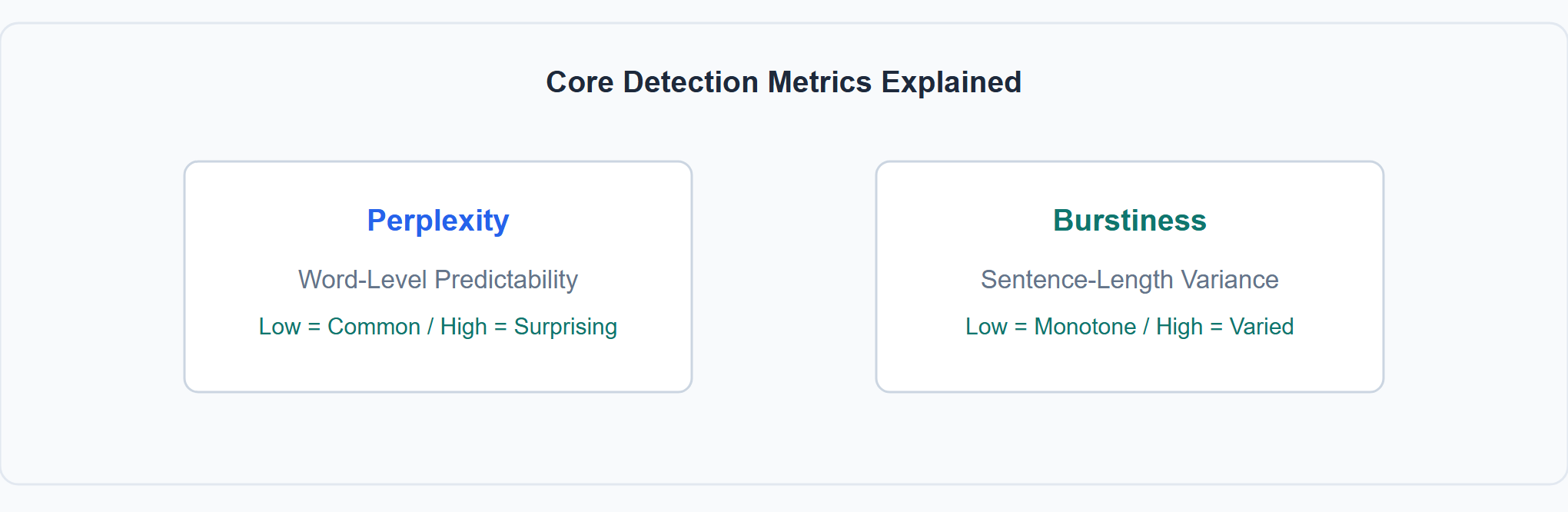
Perplexity is defined as a mathematical score of how surprising a sequence of words is to a language model. Burstiness refers to the variation in sentence length and rhythm across a text. Cross-entropy means the measure of difference between two probability distributions. Higher burstiness reflects natural human variations in syntax, creating dynamic peaks and valleys that contrast with the uniform distributions typical of machine-generated prose.
What technical terms define detector errors and performance?
Key performance terms include false positives, false negatives, classification thresholds, and precision. Each metric measures a specific type of error.
| Term | Plain-English Definition | Why It Matters |
|---|---|---|
| False Positive | Human text incorrectly labeled as AI | Leads to wrongful academic or professional accusations |
| False Negative | Machine text incorrectly labeled as human | Allows unreviewed AI text to pass undetected |
| Decision Threshold | The confidence cutoff dividing human and AI labels | Aggressive thresholds increase false alarms |
| Tokenization | Splitting raw text into numerical subword units | Determines how models calculate probability curves |
When reading a detector report, always look for the decision threshold. For instance, research from ACL RAID (2024) shows that shifting the threshold by just 10% can double false flag rates. Consider testing your own work on our AI writing detector to check your text metrics.
How should writers use these terms to protect their work?
Writers should understand these terms to explain their authentic writing style when questioned. Documenting your drafting process disproves statistical assumptions.
When revising drafts, use our text revision tool to improve sentence flow while preserving your meaning. For research standards, review your draft on our AI writing detector.
- Explain how your technical vocabulary naturally lowers perplexity.
- Show how varied sentence lengths demonstrate authentic human burstiness.
- Present draft timestamp histories showing iterative typing sessions.
- Review established evaluation guidelines for fair assessment advice.
Common questions
What does high perplexity mean in an AI detector?
High perplexity means your word choices were unexpected to the model. Detectors typically interpret this as a sign of human writing.
What does low burstiness mean?
Low burstiness means your sentences are all roughly the same length. AI models often generate text with low burstiness.
What is a classifier in AI detection?
A classifier is a machine learning model that takes text metrics and outputs an estimated probability that the text is AI-generated.
Sources and further reading
- NIST 2024 GenAI Text Evaluation Study — Federal technical standards and metric definitions
- ACL 2024 RAID Benchmark — Standard benchmark for evaluating detector metrics
- Stanford Study on Detector Metrics (Liang et al.) — Analysis of perplexity biases across diverse language groups
Related TruthDraft tools and guides
- AI writing detector — test text patterns and evaluate false-positive risk.
- Text revision tool — explore alternative phrasing while preserving factual accuracy.